
“Oh my God, what just happened?!” Cheltenham fans were utterly stunned by the chaotic nightmare at Fakenham – the initial ugly scene quickly culminating in a horrific spectacle at the final barrier, where the eventual winner was disqualified for a reason so insane no one could believe their eyes!
As the Cheltenham Festival captivated audiences with its high-stakes drama and elite competition in mid-March 2026, a parallel spectacle unfolded at the quieter Norfolk track of Fakenham. While many racing enthusiasts were tuned into the prestigious jumps action at Prestbury Park, those switching channels or streaming alternative coverage on Racing TV were left speechless by events in the concluding race of the day on Friday, March 13.
The Pointing Pointers Queen’s Cup ‘Grassroots’ Open Hunters’ Chase, a three-mile contest over fences with just four declared runners, descended into one of the most disturbing and widely condemned finishes seen in British horse racing in recent memory.
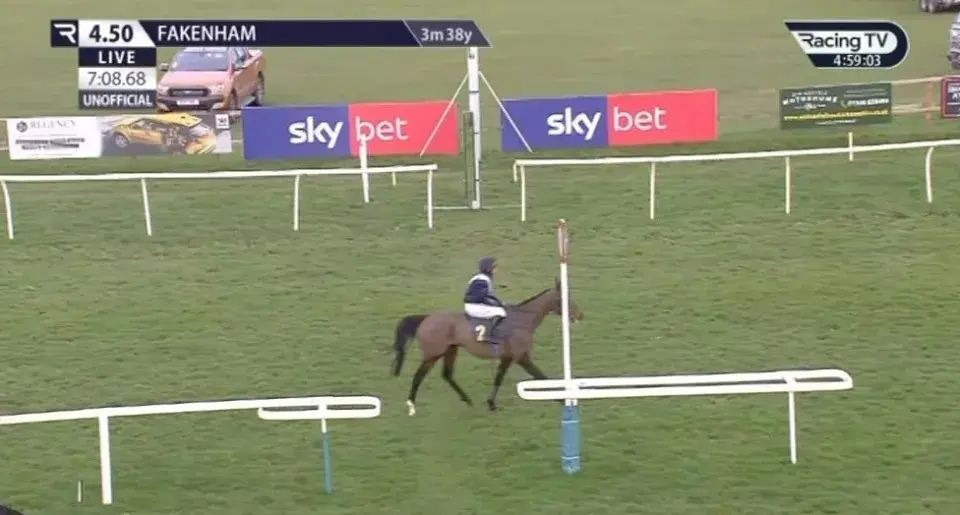
The race began ordinarily enough for a modest hunter chase held in the shadow of the Festival. Go On Chez, a 10-year-old gelding trained by Fred Hutsby and ridden by amateur jockey Charlie Marshall, went off at 7-2. The 5-4 favorite Janika, under Charlotte Butler, appeared the one to beat, with the other two runners quickly fading from contention. By the time the field approached the second-last fence, chaos had already begun to unfold. Janika, seemingly in command after the others had exited the contest through falls or pull-ups, was suddenly bumped and unseated her rider.
This left Go On Chez as the sole remaining participant, turning what should have been a straightforward canter home into an unexpected solo effort.
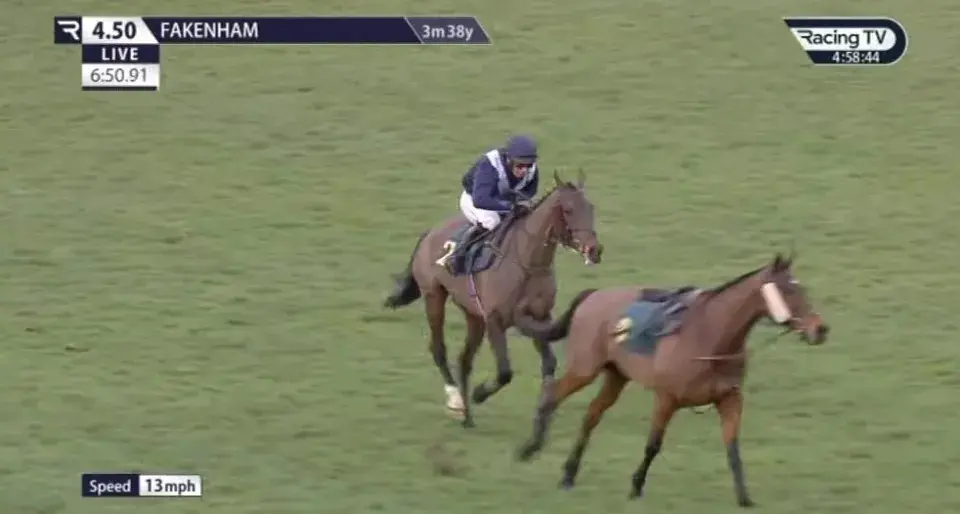
What followed, however, transformed the race from merely anticlimactic to profoundly troubling. As Go On Chez neared the final fence, the horse visibly slowed dramatically, almost to a walk. Observers, including those watching from afar while awaiting Cheltenham’s finale, described the animal as clearly exhausted, with little left to give after the grueling three miles. The gelding appeared reluctant, hesitating and showing signs of severe fatigue. Yet, rather than easing off or pulling the horse up—a standard welfare consideration in such circumstances—Marshall continued to urge his mount forward.
The horse barely scrambled over the obstacle in a labored, ungainly fashion, landing awkwardly before picking up into a slow trot toward the line.
Viewers and commentators reacted with immediate disbelief and outrage. Social media erupted with phrases like “What have we just witnessed?” and descriptions of the scenes as “horrific” and “among the most unedifying in the sport.” Many pointed out that the horse’s condition at the fence raised serious questions about equine welfare, especially in a discipline like hunter chases where amateur riders often take part. The slow-motion struggle stood in stark contrast to the glamour and precision of Cheltenham, amplifying the shock for Festival spectators who had flipped over during a lull.
The British Horseracing Authority (BHA) stewards wasted no time in launching an inquiry. They reviewed footage, interviewed Marshall, and consulted a veterinary officer. The official report was damning: it concluded that Marshall had “continued in the race when the horse appeared to have no more to give after barely being able to negotiate the final fence.” For this breach—failing to pull up a tired horse—he received the maximum penalty of a 12-day suspension, to be served on dates notified by the BHA head office.
Notably, despite widespread assumptions and dramatic headlines suggesting disqualification of the winner, the result stood. Go On Chez was not disqualified; the offense centered on the rider’s judgment during the race rather than any post-race infraction like a positive doping sample or weighing error. The horse crossed the line unopposed and retained the victory, though the manner of it left an indelible stain. Marshall’s persistence ensured a technical win, but at a significant cost to his reputation and immediate riding future.
The incident sparked broader debate within the racing community. Critics argued it highlighted ongoing concerns about welfare standards, particularly in lower-profile races where scrutiny might be less intense. Supporters of Marshall countered that the horse may have been “jibbing” (refusing to exert effort) rather than entirely spent, and that the amateur rider made a split-second decision in a lonely, high-pressure moment. Veterinary checks post-race reportedly confirmed no immediate serious injury, but the visual evidence of the struggle spoke louder than any subsequent assurances.
For Cheltenham fans, the juxtaposition could not have been more jarring. One track hosted champions and legends; the other delivered a moment that prompted soul-searching about the sport’s treatment of its equine athletes. As clips circulated online, the phrase “Oh my God, what just happened?” became a refrain, encapsulating the collective bewilderment. The Fakenham finale served as an unwelcome reminder that horse racing, for all its thrills, carries inherent risks and ethical responsibilities that demand constant vigilance.
In the aftermath, calls grew for stricter guidelines on when riders must pull up fatigued horses, with some suggesting mandatory veterinary intervention in such solo finishes. The BHA’s swift action was praised by many, yet the episode underscored that welfare decisions often rest with the individual in the saddle. As the dust settled, Go On Chez’s win remained on record, but the memory of that agonizing final fence—and the stunned silence that followed—lingered far longer.
This bizarre chapter at Fakenham, unfolding against Cheltenham’s spotlight, reinforced that racing’s drama is not always glorious. Sometimes, it is uncomfortable, contentious, and profoundly human in its flaws. The sport moves on, but lessons from such nights ensure it evolves, one controversial finish at a time.